By Joe Maier · November 16, 2026
Many 401(k) plans have changed how they operate under the SECURE Act and SECURE 2.0, and the written plan document has to catch up. In September the IRS clarified which amendments are due this year and which come later.
Since 2019, the SECURE Act and SECURE 2.0 have changed a long list of 401(k) rules. Some changes are required. Others are optional features a plan can add, like Roth employer contributions or new kinds of withdrawals. Plans were allowed to start operating under many of these rules before their written plan documents were updated.
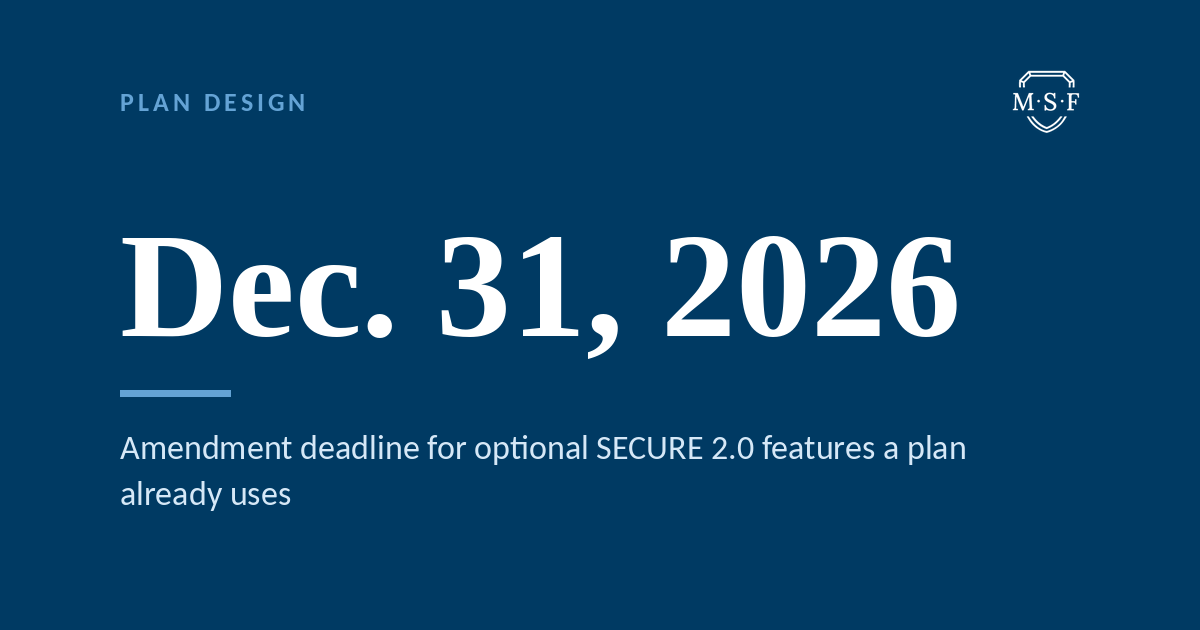
For some of those features, that window closes soon. In September 2026, the IRS clarified that December 31, 2026 is the amendment deadline for some changes, not all of them.¹
A discretionary amendment covers a feature the law allows but does not require. For non-governmental 401(k) plans that are not collectively bargained, if the plan has put one of these features into operation, the written amendment is generally due by December 31, 2026.¹ ² Examples include:³
The IRS gives the example of a plan that began allowing Roth matching contributions in 2023: it has until December 31, 2026 to adopt the amendment.¹ Qualified long-term care distributions have an extra year, to December 31, 2027.³
The deadline is about features the plan is already using. An optional feature the plan has not put into operation does not need an amendment by this date.¹
Amendments for changes the law requires follow the IRS Required Amendments List. They are generally due by the end of the second year after an item is added to that list.¹ For the Roth catch-up requirement for higher earners, the IRS expects that date to be December 31, 2029.¹ Deadlines for automatic enrollment in new plans and for long-term part-time employees will be set after final regulations are issued.³
Collectively bargained plans and governmental plans have later deadlines.³
A plan has to follow its written terms. If a plan is operating a feature its document does not describe and the amendment deadline passes, the gap becomes a compliance issue to correct, often through the IRS correction program. The IRS updated that program on October 22, 2026.⁴
Each optional feature gives employees more flexibility, and each one adds something to administer: a payroll setting, a distribution rule, a notice. The plan document, payroll and the recordkeeper all have to describe the feature the same way. When one of them changes without the others, that is where gaps tend to appear.
Many plans use a pre-approved document from their recordkeeper or administrator, and that provider usually prepares the amendments. Someone at the company still has to review and sign them.
If you would like a second set of eyes on what your plan has adopted, start a conversation.
¹ Internal Revenue Service, Employee Plans News, “Clarifying Deadlines for SECURE and SECURE 2.0 Required and Discretionary Plan Amendments,” Sept. 16, 2026.
² Internal Revenue Service, Notice 2024-2.
³ Mayer Brown, “IRS Clarifies Amendment Deadlines for SECURE and SECURE 2.0 Plan Amendments,” Oct. 16, 2026.
⁴ Internal Revenue Service, Revenue Procedure 2026-34, released Oct. 22, 2026.
This information was developed as a general guide to educate plan sponsors, but is not intended as authoritative guidance or tax or legal advice. Each plan has unique requirements, and you should consult your attorney or tax advisor for guidance on your specific situation. In no way does advisor assure that, by using the information provided, plan sponsor will be in compliance with ERISA regulations.