By Joe Maier · November 2, 2026
When an employee leaves before they are fully vested, part of the company's contributions stays behind in the plan. Here is what the rules allow a plan to do with that money, what the recent lawsuits are about, and what to check in your own plan.
Many 401(k) plans put company contributions on a vesting schedule. Employees earn ownership of the match or profit sharing over several years of service. When someone leaves before they are fully vested, the unvested part of the company's money comes out of their account and stays in the plan. That money is called a forfeiture.
Forfeitures are held in a separate account inside the plan until they are used. In a company with steady turnover, that balance can build up faster than people expect.
Under proposed IRS regulations issued in February 2023, a defined contribution plan can use forfeitures in three ways, as its plan document specifies:¹
The same proposal sets a deadline. Forfeitures are to be used no later than 12 months after the close of the plan year in which they occurred. For a calendar-year plan, forfeitures from 2026 would be used by the end of 2027. The IRS has said plans may rely on the proposed rules while they are pending.¹
A forfeiture balance that sits past that deadline, or that is used in a way the plan document does not allow, can be a compliance issue the plan has to correct.
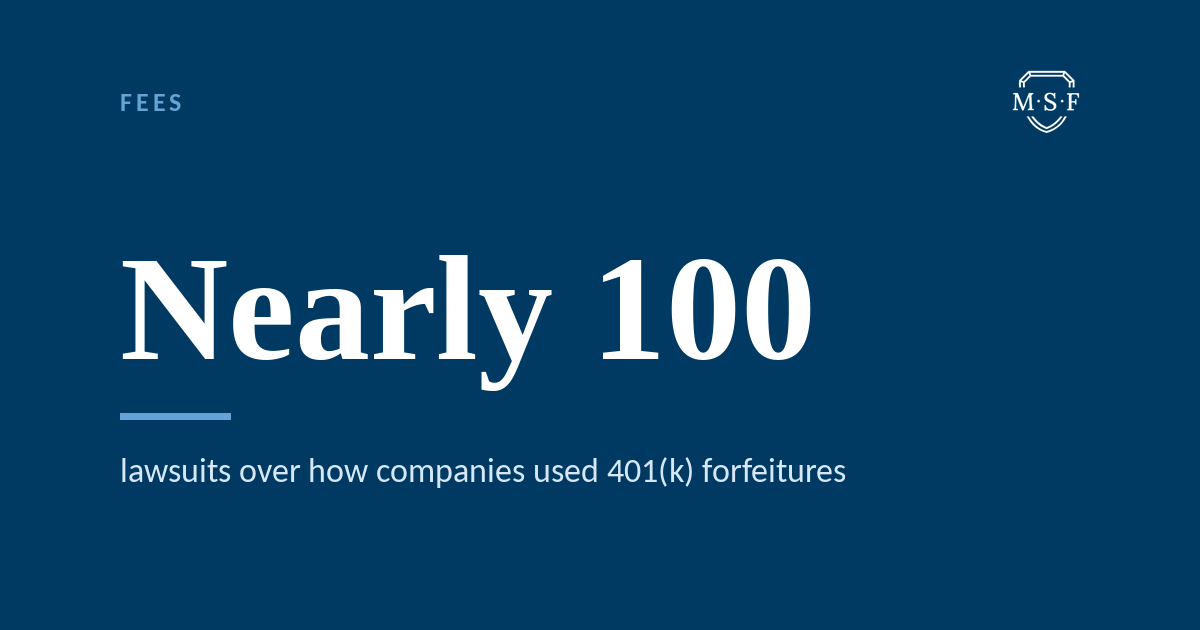
Starting in 2023, participants began suing employers over the second use. The typical claim says the company used forfeitures to lower its own matching contributions when the money could have paid plan fees that participants were otherwise paying. By March 2026, Bloomberg Law counted nearly 100 of these suits.²
More than two dozen employers have won dismissals, with courts often pointing to the IRS's long-standing acceptance of using forfeitures to fund employer contributions. A smaller number of cases have been allowed to move forward.² The Department of Labor has filed briefs supporting employers in several appeals, arguing that using forfeitures this way, when the plan document allows it, does not by itself violate ERISA.³
The first appeals court decision, from the Eighth Circuit in May 2026, ended that case because the former employee did not show the practice reduced his own account. It did not decide whether the practice itself was proper.⁴ Appeals in other circuits are still pending.
Each of the three uses puts the benefit somewhere different. Reducing employer contributions lowers the company's cost of the match. Paying plan expenses lowers what participants pay. Reallocating adds to the accounts of the people still in the plan.
Using forfeitures to fund employer contributions is permitted and common. In my experience, the harder questions come from plan language that leaves the choice open, and from decisions nobody wrote down.
Your recordkeeper can usually report the forfeiture balance and how it was used each year. The plan document or adoption agreement has the language on permitted uses.
None of this requires changing anything. It requires knowing what your plan says and what it did.
If you would like a second set of eyes on your plan's forfeiture language, start a conversation.
¹ Internal Revenue Service, proposed regulations, “Use of Forfeitures in Qualified Retirement Plans,” 88 Fed. Reg. 12282 (Feb. 27, 2023).
² Bloomberg Law, “Rising Tide of 401(k) Forfeiture Suits Reaches Appellate Level,” March 16, 2026.
³ U.S. Department of Labor amicus briefs, including Hutchins v. HP Inc., No. 25-826 (9th Cir.), filed July 9, 2025.
⁴ Matula v. Wells Fargo & Co., 175 F.4th 958 (8th Cir. 2026).
This information was developed as a general guide to educate plan sponsors, but is not intended as authoritative guidance or tax or legal advice. Each plan has unique requirements, and you should consult your attorney or tax advisor for guidance on your specific situation. In no way does advisor assure that, by using the information provided, plan sponsor will be in compliance with ERISA regulations.